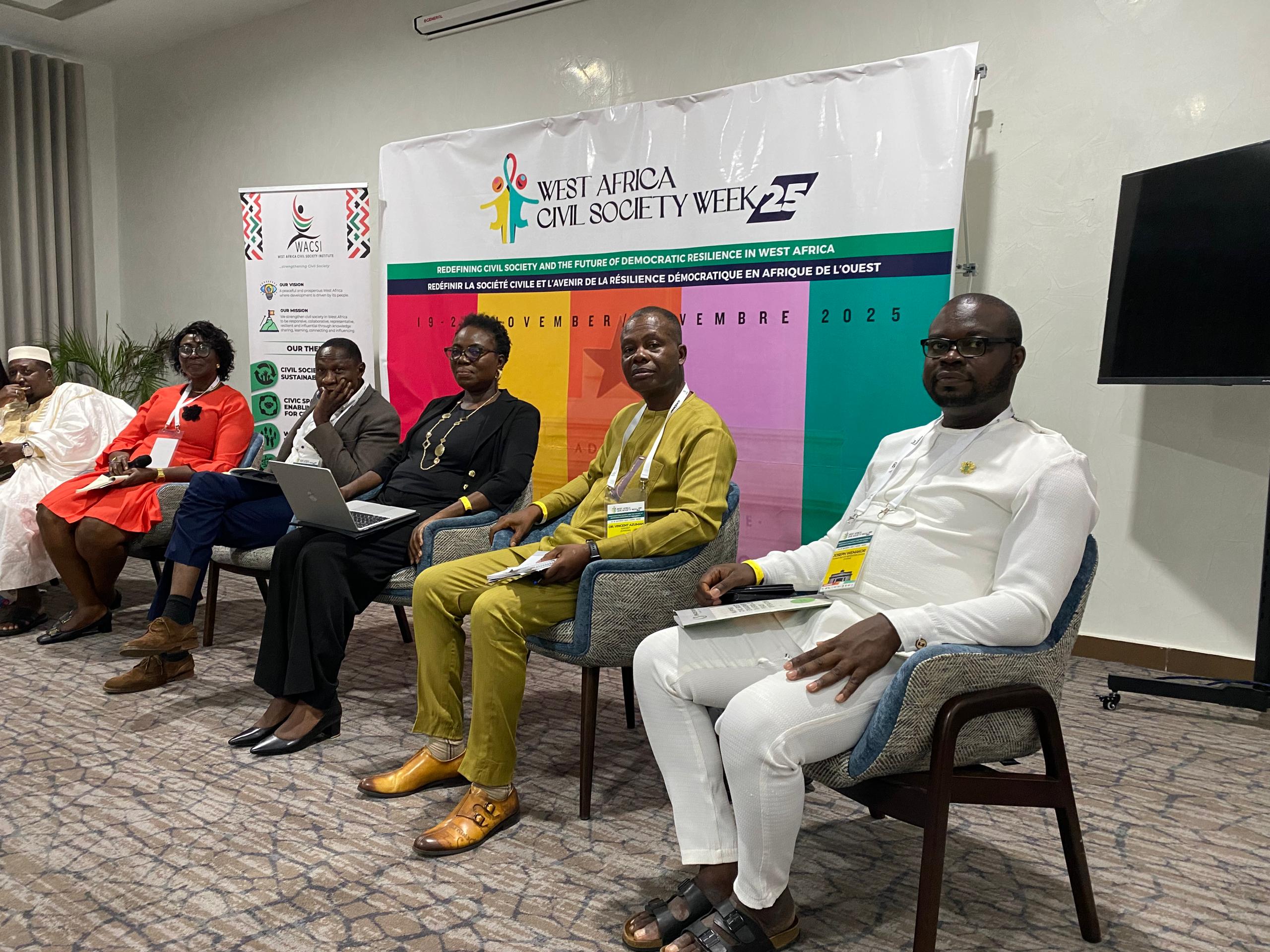
The Executive Director of Human Rights Reporters Ghana (HRRG), Dr. Joseph Kobla Wemakor, has urged civil society organizations (CSOs) across Africa to strengthen collaboration and unity to promote sustainable peace, security, and justice.
He made the appeal while speaking as a panelist at the 3rd West Africa Civil Society Week (WACS Week 2025), held from 19–20 November at The Palms by Eagle Hotel, Accra.
The two-day event brought together over 300 civil society actors, peacebuilders, human rights advocates, and youth leaders from more than 10 West African countries.
Featuring 15 interactive sessions and two plenaries, the program provided participants with platforms to engage in discussions on civic space, governance, peace, and security challenges across the region.
Peace, Security, and Justice Imperatives Dr. Wemakor contributed to Session 3(b) on “Peace, Security and Justice Imperatives”, hosted by the West Africa Network for Peacebuilding (WANEP) and chaired by Dr. Vincent Azumah, Head of Monitoring and Evaluation at WANEP.
Addressing peacebuilders, civic activists, and regional policymakers, Dr. Wemakor highlighted several structural challenges facing Africa-led peace and counterterrorism operations, including poor coordination, limited resources, and weak leadership. He urged CSOs to collaborate, support one another, and unite to complement governments and other stakeholders in achieving sustainable peace, security, and justice.
Evidence-Based Call to Action
Dr. Wemakor’s recommendations were informed by findings from the 50-page report, Mapping Civil Society Engagement in Africa-Led Peace Operations, published by Spaces for Change (S4C).
The research comprehensively maps CSO contributions across conflict-affected regions, covering counterterrorism initiatives, peacebuilding, community engagement, capacity-building, and humanitarian actions.
He dedicated the report to civil society actors, policymakers, government institutions, and the public, urging all to read it and take informed action.
The findings underscore gaps in civil society participation at the policy level and the urgent need for CSOs to be meaningfully included in the design and implementation of security initiatives.
Dr. Wemakor further stressed that Africa’s leadership crisis is structural, not just political, calling for bottom-up sensitization to transform leadership practices across civic, governmental, and intergovernmental institutions.
Expert Panel Discussion Dr. Wemakor shared the panel with:
Dr. Nansata Yakubu, Director, West Africa Programme, Conciliation Resources
Mr. Kop’ep K. Dabugat, Governance, Peace, and Security Expert, Nigeria
Mr. EI Moctar Cisse, President, Collectif Cri du Coeur (CCC), Mali
Mrs. Joy Anima Debrah, Senior Public Education Officer, Commission on Human Rights and Administrative Justice (CHRAJ)
The panel engaged in a robust discussion on the importance of CSO involvement in peace operations and how civil society can strengthen accountability, justice, and preventive action in fragile contexts.
Democracy and Civic Space Under Threat
The role of civil society was highlighted by Ambassador Abdel-Fatau Musah (PhD), ECOWAS Commissioner for Political Affairs, Peace and Security, who warned at the opening plenary that democracy in West Africa faces threats from rising insecurity, governance failures, and shrinking civic space.
Other prominent voices included:
H.E. Mohamed Ibn Chambas, AU High Representative for Silencing the Guns, calling for democracy that delivers social protection beyond elections
Dr. Nana Afadzinu, Executive Director, WACSI, urging value-driven civil society action, transparency, and sustainable funding
Sola Sam-Adeniyi, Spaces for Change, highlighting violent extremism and suppression of freedoms, and advocating local solutions and strengthened capacities
Onyinye Onyemobi, Ford Foundation, emphasizing that hope is the oxygen of democracy
Nana Oye Bampoe Addo, Deputy Chief of Staff to Ghana’s President, advocating ethical engagement, community-centered peacebuilding, and multi-stakeholder partnerships
The closing plenary reaffirmed the critical role of empowered civil society in safeguarding democracy and peace across West Africa.
Key Takeaways from WACS Week 2025
- Strengthen local accountability and rebuild trust in grassroots communities
- Adopt sustainable funding models and deepen institutional capacity
- Elevate youth and women’s participation in civic processes
- Use technology responsibly to expand civic space and accountability
- Promote regional cooperation for judicial reform, governance, and anti-corruption
These takeaways reflect Dr. Wemakor’s central message that civil society is not just a partner but a critical anchor for peace and democratic resilience in Africa.
About WACS Week
The West Africa Civil Society Week (WACS Week) is an annual gathering that examines the health of civic space in the region while exploring practical pathways to enhance civil society effectiveness and democratic sustainability.
The 2025 edition, co-hosted by WACSI, Spaces for Change, and the Civil Society Resource Hub, with support from the Ford Foundation, featured 15 sessions and two plenaries, providing multiple platforms for discussion, networking, and cross-regional learning.
Leave a Reply